
The Fog of Learning
We used to have brutal clarity in education. Now we have compassionate chaos.
Back in the 1990s, the deal was simple. Teachers taught. Kids learned what they could. Some got left behind. Some schools sucked. It wasn't fair or perfect, but everyone understood the game.
Fast forward to today. We've spent thirty years and billions of dollars "fixing" education. We've got inclusion policies, differentiated instruction, personalized learning plans, educational technology, collaborative classrooms, restorative justice, and endless data tracking. Schools have never sounded more humane, supportive, and advanced on paper.
And yet, somehow, the fog has never been thicker.
Parents can't decipher what their kids are supposed to be learning. Teachers are drowning in paperwork about teaching rather than actually teaching. Kids with real learning needs wait months or years for help that's legally guaranteed but practically unavailable. And everyone - from policymakers to principals to parents - is too exhausted to admit the obvious: the system isn't working.
The fog is everywhere, obscuring the hard truths about what happens when ambitious educational theories collide with underfunded reality. This isn't about liberal vs. conservative views on education. It's about what happens when any system tries to solve complex human problems with bureaucratic solutions and insufficient resources.
The Theater of "Modern Education"
"We've supposedly got some of the most advanced learning systems in the world. Every child gets their needs assessed. Every teacher is trained in differentiation. Every school has accountability metrics. Sounds pretty good, right? So why does my son come home unable to tell me what he learned today, while his teacher spent the evening entering data rather than designing tomorrow's lesson?" – Parent, UK secondary school
Let me pull back the curtain on what education actually looks like from the inside in 2025:
For teachers: Wake up at 5 AM to finish marking because yesterday's staff meeting about "reducing workload" ran long. Teach classes of 30+ students with widely varying needs, several without the support they're legally entitled to because there's a shortage of special educators. During your "planning period," respond to 15 urgent emails and update the online gradebook parents will check tonight. After school, attend another meeting about improving test scores, then go home to plan tomorrow's differentiated lessons for the students who are three years behind and the ones who are two years ahead. Fall asleep grading at 11 PM.
For students: Sit through lessons where the teacher must simultaneously challenge the advanced kids and support those still mastering basics from three years ago. Get shuffled into intervention groups based on data points rather than actual needs. If you're struggling, wait months for help. If you're advanced, pray you get a teacher with enough bandwidth to challenge you. If you have behavioral issues, bounce between punitive and permissive approaches depending on which administrator is making policy this year.
For parents: Try to decipher educational jargon that masks simple concepts. ("Your child is 'developing toward age-related expectations'" - so... below grade level?) Check three different apps to piece together what's happening in the classroom. If your child needs support, prepare for a bureaucratic maze that requires you to become an amateur educational lawyer to navigate. If you can't dedicate dozens of hours to advocacy, watch your child's needs go unmet.
This is the system we've built: a fog so thick that even the people inside it can't see clearly.
The Burnout Machine
Modern education has evolved into a burnout machine, systematically grinding down the very people it depends on while pretending to care about their wellbeing.
A veteran UK teacher reflecting on the 1980s/90s recalled: "The hours I worked were between 45 to 50, including marking." By the late 2000s? "I now work on average 60 hours a week." The National Education Union's 2023 survey found teachers averaging 52.4 hours weekly, with only a fraction of that time spent actually teaching.

What's changed isn't just the hours but what fills them. Another teacher explained: "All the administrative tasks I completed in the early 1990s are still there, but there are many new responsibilities - analysis of data, preparing for Ofsted, monitoring and documenting everything."
Even the most basic teaching task - giving feedback on student work - has morphed from what one teacher called a "tick-and-flick exercise" to a bureaucratic performance: "We still put a tick to show we've seen the book, but now we have to fill in a stamp setting targets and leave comments on how pupils are working. One set of books can take 2–3 hours to mark."
The American situation is no better. The RAND Corporation found US teachers working 53 hours weekly in 2023 - seven more than the average professional - with about 25% of that work uncompensated. They're drowning in paperwork, data entry, and compliance tasks that didn't exist a generation ago.
Is it any wonder that 94% of UK teachers who considered leaving cited "high workload" as their primary reason? Or that districts across America face crippling teacher shortages?
The supreme irony: as education systems produce PowerPoints about "teacher wellness" and "work-life balance," they simultaneously implement policies that make those concepts impossible. The system burns through teachers, then acts shocked when no one wants the job.
The Inclusion Illusion
The most heartbreaking gap between educational rhetoric and reality involves students with special needs. Both countries have spent decades crafting beautiful frameworks for inclusive education. The language is impeccable: every child deserves support, every learner belongs in the mainstream, every difference should be accommodated.
The actual experience? A cruel bait-and-switch that promises support but delivers bureaucratic obstruction.
In England, only 50% of Education, Health and Care Plans (the legal documents outlining support for special needs) are issued within the statutory 20-week timeline. Half of the students legally entitled to support wait months or years to receive it. Meanwhile, the number of tribunal appeals has skyrocketed from 6,000 in 2018 to 15,600 in 2023, with 98% of decisions favoring parents. This isn't just system failure - it's system design.
James, father of an autistic 10-year-old in Birmingham, puts it bluntly: "The system is designed to wear you down until you give up. They denied our request for assessment twice, claiming Sam's struggles were 'normal developmental issues' despite his diagnosis. We had to hire a lawyer we couldn't afford to get what the law already promised. Meanwhile, Sam lost two years of support he'll never get back."
The American experience is equally disturbing. The Government Accountability Office identified critical personnel shortages affecting special education services nationwide. Without enough special educators, therapists, and paraprofessionals, many students receive delayed services, lower-quality support, or nothing at all.
Lisa, a special education teacher in Michigan, describes the impossible situation: "I have 28 students on my caseload when the recommended maximum is 15. I'm legally required to provide specific minutes of service to each child, but there literally aren't enough hours in the school day to do it. So either I cut corners or work unpaid hours. And parents have every right to be angry - their kids deserve better."
The consequences show up in the data. In England, young people with SEN are much less likely to be in education, employment, or training after ages 16-18 compared to their peers (69% vs. 85%). In the US, the graduation rate for students with disabilities was about 70% in 2020, versus 86% for all students.
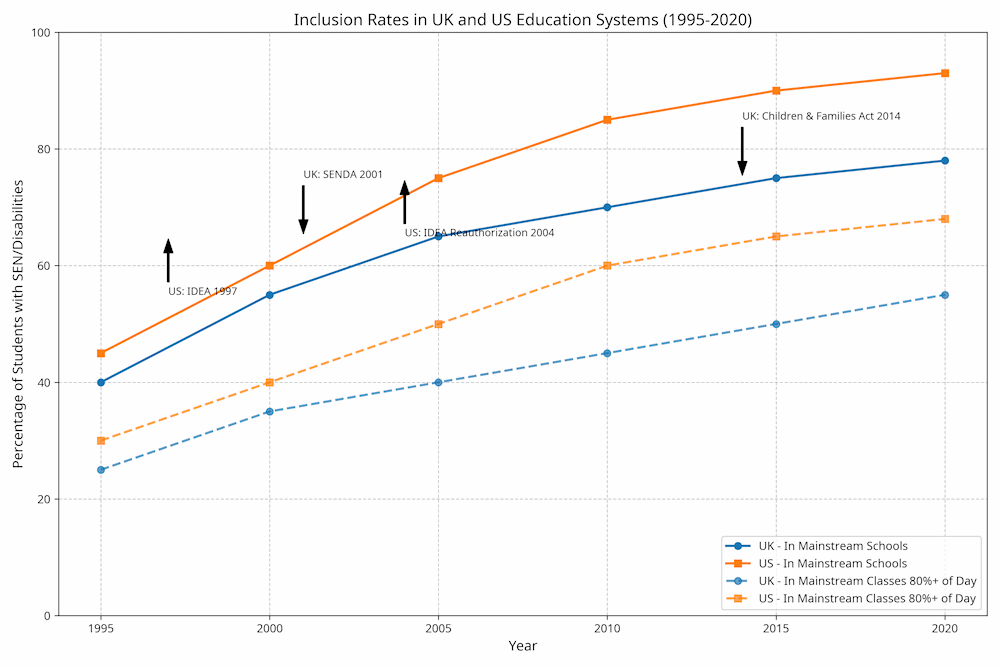
This is the ugly reality behind the glossy inclusion brochures: systems that promise support while structurally ensuring they can't deliver it. It's not inclusion; it's gaslighting on an institutional scale.
The Invisible Middle
In the chaos of modern education, one group has become nearly invisible: the average student who neither fails enough to trigger intervention nor excels enough to warrant enrichment.
Meet Aiden, a quiet Year 9 student in Leeds. He's not disruptive. He's not failing. He's not exceptional. He's just... there. In a class of 32, with four students with significant behavioral needs, three with learning disabilities, and two who are academically years ahead, Aiden is easy to overlook. He turns in most assignments. His test scores are solidly middle-of-the-pack. He rarely raises his hand.
His English teacher, Ms. Parker, knows she should push him more. She's seen flashes of insight in his writing that suggest untapped potential. But with so many urgent needs competing for her attention and so much administrative work to complete, Aiden gets what she can give him - which is never enough. Her time and energy are consumed by crisis management, documentation, and the students at either extreme of the performance spectrum.
Aiden isn't alone. He represents countless students in the educational middle ground - not struggling enough to trigger interventions, not excelling enough to draw special attention. They move through the system getting just enough education to get by, their potential neither identified nor developed. They are the collateral damage of a system so focused on fixing problems and measuring extremes that it neglects the broad middle.
American schools face the same issue. Driven by accountability metrics and legal mandates, they concentrate resources on students at risk of failing standardized tests and those with documented special needs. The middle drifts along, passing but not thriving, collecting educational participation trophies but missing opportunities for genuine growth.
Sarah, a middle school teacher in Pennsylvania, describes the dilemma: "I know exactly which students in my class could be doing so much better with more individual attention and challenge. But between supporting the kids who are three years behind grade level, managing behavior issues, and completing all the required documentation, there's no time left for the quiet B students who could be A students with the right push."
The cruel irony is that these "middle" students often come from families without the resources to supplement their education through tutoring, enrichment programs, or advocacy. They depend entirely on an overwhelmed system that has little time or incentive to help them reach their potential. They aren't failing badly enough to matter in the data, so they become educational afterthoughts.
This isn't what anyone designed or what any educator wants. But it's the inevitable result of a system that demands everything, measures constantly, and funds inadequately.
Teaching to the Spreadsheet
Education has always involved assessment, but the modern obsession with data has warped classroom reality beyond recognition. We've crossed the line from measuring learning to manufacturing metrics that distort the very thing they claim to measure.
Under No Child Left Behind in the US, schools transformed into testing factories, with teachers pressured to "teach to the test" in reading and math while other subjects withered. Research confirmed what every teacher already knew: instructional time shifted dramatically toward tested subjects at the expense of science, social studies, arts, and physical education. The curriculum narrowed to what could be easily measured, not what actually matters for developing minds.
In England, Ofsted inspections trigger similar distortions. As one teacher described: "The entire school stops for weeks preparing for Ofsted. We create special displays, rehearse answers to expected questions, and rewrite policies. Then we put on a grand performance for inspectors that bears little resemblance to normal school life." It's educational theater, not educational improvement.
The fixation on measurable outcomes has created a perverse dynamic where what's measured becomes what matters - regardless of its actual value to children's development or learning.
Mark, a head of department at a London comprehensive school, has watched this transformation: "I've seen my department's teaching gradually narrow to focus on what data systems can track. Complex discussions about literature have been replaced by formulaic responses that score well on rubrics. We teach students to write essays using templates that hit all the mark scheme points rather than developing their authentic voice. Why? Because the data team needs quantifiable improvements to report upward."
This data obsession now permeates every aspect of school life - behavior management, attendance tracking, intervention grouping, teacher evaluation. Teachers spend hours feeding information into systems that generate reports few people read and fewer act upon. Schools purchase expensive data platforms that promise to "analyze learning gaps" but mostly create prettier ways to display test scores.
Meanwhile, the actual humans in the classroom fade behind numerical abstractions. Samantha, a mathematics teacher in Arizona, explains what's been lost: "I used to know my students as people - their strengths, struggles, interests. Now I know them as data points. This kid is a '67% proficient.' That one is '2.3 years below grade level.' The system wants me to make those numbers go up, even if the methods that would truly help that specific child don't generate immediate statistical improvements."
When spreadsheets drive decisions, education becomes a game of manufacturing numbers rather than developing minds. The metric has become the mission.
The Illusion of Choice
Both countries have enthusiastically promoted "parental choice" as the solution to educational challenges. But the reality of choice is very different depending on who you are and where you live.
In theory, English parents can choose any school for their child. In practice, oversubscription means popular schools use selection criteria - sometimes academic ability, sometimes faith requirements, often simple geography. Living near a good school requires financial resources many families don't have.
The rise of academies and Multi-Academy Trusts was supposed to improve options, but the evidence of their superiority is mixed at best. Some MATs perform brilliantly, others dismally. The median performance may be slightly lower in MATs than maintained schools, but the top-performing MATs outperform the top maintained schools, while the lowest-performing MATs lag behind the weakest maintained schools.
What's most telling is which parents actually navigate the system successfully. Those with time, education, social capital, and transportation consistently secure better options, while disadvantaged families remain in struggling schools.
Even when disadvantaged families technically have choice, the barriers are substantial. Complicated application processes, insufficient information, transportation challenges, and work schedules that prevent school visits all limit real choice for those who need it most.
Rebecca, a single mother in Manchester, describes her experience: "They told me I had 'school choice,' but the reality was I could only consider schools within walking distance because I work two jobs and can't drive my son across town. The 'outstanding' school nearby was oversubscribed, and we live 0.1 miles too far away to qualify. So he goes to the struggling school on our street, while I watch middle-class parents drop their kids off at the good school in cars."
The American experience mirrors this. Charter schools, voucher programs, and magnet options have created a complex marketplace that, in theory, offers unprecedented choice. In practice, families with resources navigate the system effectively, while others remain in under-resourced neighborhood schools.
The marketing of choice has far outpaced its equitable delivery.
The Technology Treadmill
EdTech was marketed as the savior of modern education - making teachers' lives easier and learning more engaging through digital innovation. The reality? A perpetual treadmill of new tools and platforms that create more work than they eliminate.
Email perfectly illustrates this shift. As one UK teacher observed: "A classroom teacher gets about 30 emails a day - that did not happen in 1993." What was once an occasional memo in a physical mailbox has become an endless torrent of messages requiring immediate response, with the unspoken expectation that teachers remain perpetually available even outside school hours.
Beyond basic communication, educational technology follows a predictable and exhausting cycle: enthusiastic adoption, incomplete implementation, diminishing returns, and eventual abandonment - usually just as teachers have finally adjusted to using it. Then the cycle repeats with the next "revolutionary" platform.
Jessica, an elementary teacher in California, has lived this cycle repeatedly: "In my 15 years of teaching, I've been required to learn and implement seven different educational platforms, each promised as 'the solution' to personalized learning. By the time I'm proficient with one, the district switches to another. Meanwhile, the basics - like having enough physical books for students or time to plan quality lessons - remain neglected."
The promised academic benefits haven't materialized either. A global OECD study found that "investing heavily in school computers and classroom technology does not improve pupils' performance" on core assessments. More troublingly, students who used computers "very frequently" at school actually scored worse in reading.
Even when technology functions properly, it creates cascading demands. Online gradebooks give parents instant access to scores but generate constant questions requiring explanation. Learning management systems organize materials nicely but demand hours of uploading and maintenance. Remote learning platforms opened new possibilities during the pandemic but created an expectation that teachers should now maintain both physical and digital teaching simultaneously.
Martin, a secondary teacher in Leeds, captures the fundamental contradiction: "I'm not against technology. I use it daily and see its benefits. But it's sold as a time-saver when it's actually a time-shifter. It changes what I do with my time, rarely reducing my overall workload. And the constant expectation to master new systems while maintaining everything else is exhausting."
The EdTech industry keeps promising revolution while delivering complication, leaving educators perpetually running to master the latest platform while the fundamentals of good teaching get lost in the digital noise.
The Behavior Breakdown
The most visible crack in education's glossy facade is the daily reality of classroom behavior. While policy documents wax poetic about "positive learning environments" and "restorative approaches," the lived experience in many schools is chaos masquerading as inclusion.
In England, exclusion data tells the ugly truth. After declining in the early 2000s, permanent exclusions have surged, reaching about 9,400 in 2022-23. Suspensions have likewise skyrocketed. Behind these numbers are classrooms where learning is constantly derailed by disruption, where teachers spend more time managing behavior than teaching, and where compliant students watch their education evaporate while schools struggle to address the needs of their most challenging peers.
Emma, who teaches Year 8 English in Sheffield, describes her daily reality: "I spend about 40% of each lesson managing behavior rather than teaching. It's not usually major incidents but constant low-level disruption - students talking over me, using phones despite policies against them, refusing to work, making unkind comments to peers. By the time I address these issues and get everyone refocused, half the lesson is gone."
The American situation mirrors this. Schools have whiplashed between extreme approaches - from the draconian zero-tolerance policies of the 1990s (which disproportionately impacted minority students) to poorly implemented "restorative justice" programs that often lack the training, staffing, and time needed to function effectively.
The result is a bizarre situation where schools simultaneously have too much punishment and too little structure. The wrong students get hammered with severe consequences (typically Black and brown students committing subjective offenses like "disrespect"), while general classroom disruption goes unaddressed due to administrative fear of exclusion statistics or lack of coherent alternatives.
Maria, who teaches in Boston, describes the dysfunction: "Our district officially uses restorative practices, but we received just two hours of training and no additional staff to implement it. So when serious issues arise, we're supposed to hold restorative conferences - but during what time? With what facilitator? Meanwhile, traditional consequences have been largely eliminated. Students quickly figured out there's no real response to misbehavior beyond conversations we don't have time to hold properly."
Complicating everything is the dramatic increase in students with significant mental health and behavioral needs who receive inadequate support. Teachers across both countries report more extreme behaviors than in previous decades, combined with less autonomy to address them effectively and fewer resources to provide the intensive interventions many students require.
The system's response to this reality is perfectly emblematic of the educational fog: Launch a new behavior initiative with an inspiring name. Create complicated flowcharts. Send teachers to a half-day training. Change nothing about resources, class sizes, or support staff. Express disappointment when teachers "aren't implementing with fidelity." Rinse and repeat next year with a different program.
Meanwhile, students who want to learn watch another day of education dissolve into behavior management, while those acting out continue without the structured support they actually need. It's a lose-lose scenario hidden behind posters about "behavior for learning" and "restorative communities."
The Mission Confusion
If you really want to understand why education feels so chaotic, try asking a simple question: What exactly is school supposed to accomplish? The answer changes depending on who you ask, what day it is, and which political party is currently in power.
Ask a roomful of educators what the purpose of education is, and you'll get a dozen answers that seemingly contradict each other: academic achievement, social-emotional development, preparation for work, citizenship training, personal fulfillment, social mobility, character building, narrowing achievement gaps...
This isn't just philosophical navel-gazing. These competing missions drive contradictory priorities, incompatible teaching approaches, and conflicting measures of success. The modern education system attempts to achieve all of them simultaneously without acknowledging the fundamental tensions between them or making conscious choices about what matters most.
Dan, a headteacher in Nottingham, lays out the absurdity: "In a typical week, I'm told our school must: raise test scores, develop character, ensure mental wellbeing, teach British values, prevent extremism, promote healthy lifestyles, close achievement gaps, prepare for future careers that don't exist yet, and compensate for societal failures from housing to healthcare. Each demand comes with its own initiative, paperwork, and accountability measure. None comes with adequate funding or a recognition that 6 hours a day with children can't solve every social problem."
American schools face the identical pressure. In a single school year, a district might simultaneously launch initiatives on standardized test improvement, bullying prevention, career readiness, mental health awareness, and digital citizenship - all while maintaining that each is the absolute top priority.
This expansion of purpose might be manageable if it came with expanded resources and a realistic assessment of what schools can achieve. Instead, schools face mounting expectations with stagnant or declining resources. "Just add it to what you're already doing" is the unspoken directive, as if the school day can infinitely expand to accommodate society's growing wish list for what education should fix.
The most insidious effect of this mission confusion is how it creates a no-win situation for schools. When they fail to improve test scores, they're criticized for poor academic focus. When they focus intensely on academics, they're criticized for neglecting social-emotional development. When they try to balance multiple priorities, they're criticized for lack of clear direction. No matter what schools prioritize, they're failing at something else someone has decided is equally essential.
This creates a perpetual cycle of reform as schools lurch from one priority to another, never settling long enough on any approach to see meaningful results before the next urgent mission arrives. Teachers develop initiative fatigue, students experience inconsistency, and everyone feels the underlying confusion of a system that's trying to be everything to everyone while lacking the resources to excel at anything.
Clearing the Fog
I'm not peddling easy solutions, because they don't exist. The educational fog has thickened over decades of well-intentioned reforms, societal changes, and complex systemic interactions that can't be reversed with a few policy tweaks or another inspirational TED talk.
But across both countries, there are rare pockets where the fog occasionally thins - places that have found ways to resist the chaos and create actual learning environments:
-
Schools with the courage to say "no." Some schools have found success by explicitly stating what they will and won't do, focusing their energy on core priorities rather than trying to meet every external demand. They set boundaries with district initiatives, limit data collection to what's actually useful, and protect their teachers from the endless churn of new programs. This clarity benefits everyone - staff know what to focus on, parents understand what to expect, and students experience consistency.
-
Leaders who treat teacher time as sacred. Exceptional principals and headteachers understand that every minute teachers spend on bureaucratic tasks is a minute stolen from students. They ruthlessly eliminate unnecessary paperwork, cancel pointless meetings, and create systems that maximize instructional time. When new mandates arrive, they ask the critical question: "What existing task will we eliminate to make room for this?"
-
Communities willing to have honest conversations about resources. When schools, families, and policymakers acknowledge the gap between lofty ambitions and available resources, they can make conscious choices about priorities. This honesty - "we cannot do everything well with what we have" - is painful but ultimately more productive than the current practice of pretending unlimited goals can be achieved with limited means.
-
Approaches built from classroom realities, not theory. The most promising innovations emerge from understanding the actual conditions of teaching and learning, not from idealized theories developed in isolation from practical constraints. When teachers are treated as experts in their craft rather than implementers of others' ideas, practical solutions emerge.
-
Schools that value stability over novelty. Where communities resist the constant churn of new initiatives and allow practices to become established, teachers develop deep expertise and students benefit from consistent expectations. Learning to do a few things exceptionally well beats doing many things poorly.
The starting point is brutally simple: we must acknowledge the fog exists. We need to admit that the current system routinely fails everyone involved - students, teachers, parents, and communities - despite the best intentions of those within it.
Real improvement won't come from another glossy framework, technological platform, or restructuring plan. It will come from having the courage to see education as it actually is, not as we wish it to be - and then making the hard choices necessary to align our aspirations with reality.
Until we find that courage, the fog will only grow thicker, suffocating the very learning we claim to value - and leaving another generation to navigate a system that promises clarity while delivering confusion.